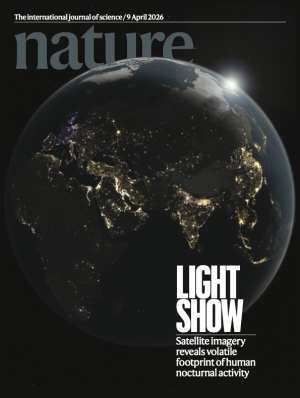
A new paper examining nighttime lights was published in the journal "Nature" on Thursday. The paper reports on changes in outdoor light emissions during 2014-2022 using data from a series of weather satellites operated by the US agencies NASA and NOAA. Previous studies using such data have either examined global lighting changes at country or continent level using monthly or yearly data, or else examined changes on small spatial scales using daily data. The authors report that in contrast to the current conceptual model of a gradual global increase, at high spatial and temporal resolutions light emissions are extremely dynamic, with many areas experiencing multiple changes in their emissions trends throughout the time series.
The authors found that global light emissions increased 16% during the observation period. This result arises from an increase in global emissions of 34% in areas that brightened, offset by an 18% decrease in global emissions from areas that darkened. Europe was the only continent to have darkened over the full time period. This darkening trend was led predominantly by France, where emissions fell 33% from 2014 to 2022. In Germany, total light emissions rose 8.9% in brightening areas, and fell 9.2% in dimming areas.
The paper was led by researchers from the University of Connecticut, in collaboration with Prof. Christopher Kyba from RUB, Theres Kuester from the GFZ Helmholtz Centre for Geosciences, and researchers from NASA and several universities in the United States.
Students interested in using nighttime lights products in their theses are encouraged to contact Prof. Kyba.

Copyright © Geographical Institute 2026
Last update: Apr 09, 2026