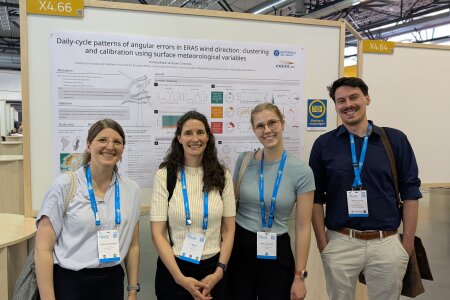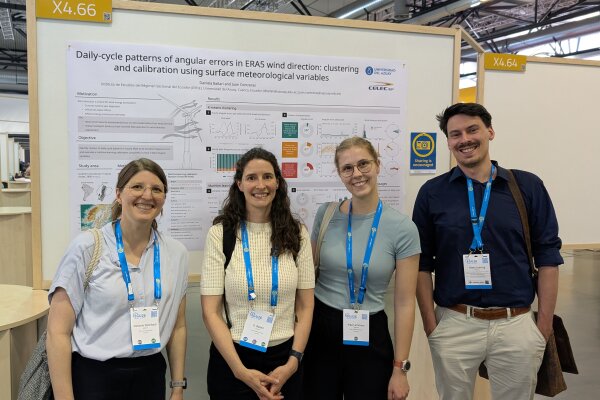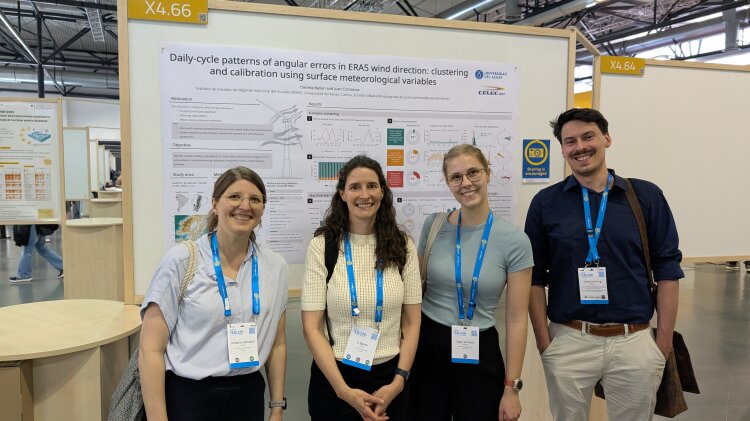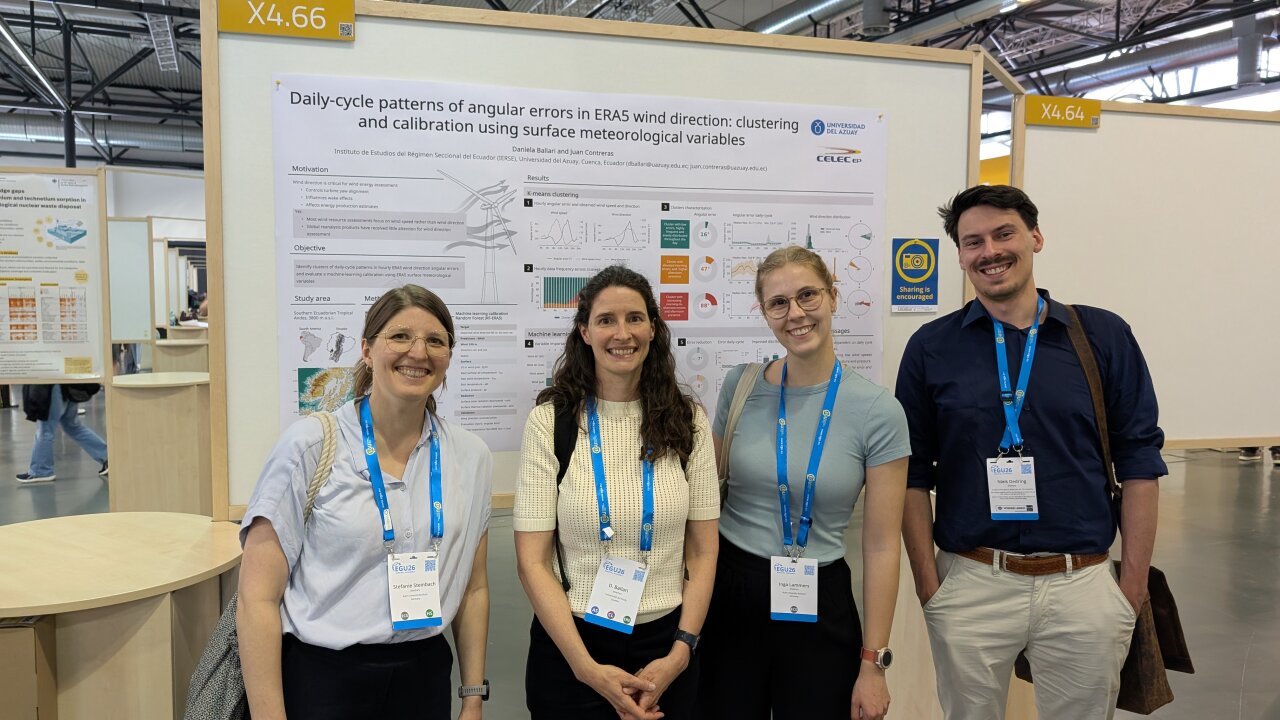
The European Geosciences Union (EGU) General Assembly 2026 took place from 3 May to 8 May with a record number of participants. A total of 22,497 participants registered, of whom 20,027 travelled to Vienna from 125 countries and over 2,470 from 107 countries participated online. With 20,173 presentations across 1,014 sessions, the event covered topics from the fields of Earth system sciences, such as cryosphere research, geomorphology, natural hazards, hydrology and many others. 58% of the abstracts submitted were from early-career researchers.
The EGU sees itself as a cross-generational and interdisciplinary network, offering a variety of presentation formats, including specialist talks, poster sessions and interactive presentations, as well as training opportunities and discussions. From the high mountains of Nepal to the tropics of Ecuador and Ghana, the Urban Remote Sensing Working Group, represented by Dr Stefanie Steinbach, Niels Dedring and Inga Lammers, was present at the EGU and also met with collaboration partners from Europe, South America and Africa. The researchers’ participation was funded by the VolkswagenStiftung, the PermaCOST Young Researchers and Innovators (YRI) conference grant (COST Action CA24157), the RUB Research School and the Ruth and Gert Massenberg Foundation.
The Abstracts are available online:
Remote sensing capabilities of detecting spatio-temporal dynamics in unregulated extractivism hotspots in Ecuador
Lammers et al.
Integrating In-Situ and Earth Observation Data to Support Understanding of Functional Water Constraints in Small Reservoirs in Ghana
Steinbach et al.

Copyright © Geographical Institute 2026
Last update: Jun 10, 2026